
I design and engineer collective intelligence.
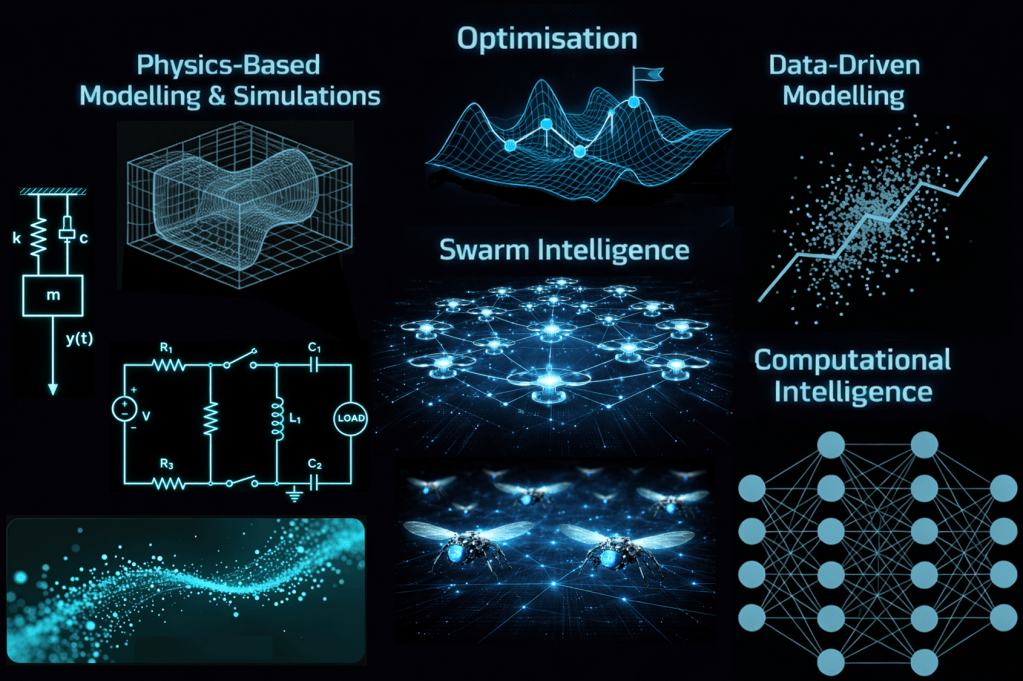
I am passionate about solving complex engineering and societal problems through applied mathematical modelling, multidisciplinary optimisation, and artificial intelligence (includig swarm intelligence and multi-agent systems). My work spans domains including fire modelling, emergency response, precision agriculture, defence and security, infrastructure inspection, environmental monitoring, and the optimal design and operation of engineered systems.
I am the Founder and CTO of SwarmMind, an innovation-driven company dedicated to the disciplined design and engineering of swarm-based intelligent systems. My focus is on building scalable collective intelligence: systems that are adaptive, verifiable, and capable of operating reliably in complex, dynamic environments.
At the core of my work lies the fundamental question of how local interactions give rise to coordinated global behaviour, and how those dynamics can be engineered with mathematical precision rather than left to emergence alone. By bridging optimisation, formal methods, and multi-agent systems, I aim to move swarm intelligence from research theory to deployable technology.
I previously held academic appointments in the UK and Spain, including Advanced Research Fellow at Imperial College London and Senior Lecturer at Coventry University, as well as research positions at Swansea University, Cardiff University, and the Universitat de Girona.
I hold a PhD in Particle Swarm Optimisation from Swansea University (UK), a Master’s in Numerical Methods from the Universitat Politècnica de Catalunya (Spain), and an Engineering degree from the Universidad Nacional del Nordeste (Argentina). This interdisciplinary foundation underpins my approach to the rigorous disciplined design of intelligent, distributed and self-organising systems.
Alongside industrial innovation, I continue to contribute to research through publications, collaborative projects, supervision of research students, doctoral examination, and peer review.
 Mauro Sebastián INNOCENTE